Aluminum Anodizing · Greenville, KY
Aluminum anodizing to MIL‑PRF‑8625F for parts from our precision machine shop or bring your own.
BluArc runs sulfuric acid anodizing to MIL‑PRF‑8625F, on aluminum only, at 104 Industrial Drive in Greenville, Kentucky. Send us the parts and they are racked, run, and checked here before anything is packed.
Largest tank
120 in
Length, on the undyed line. Send all three dimensions and we will tell you whether your part fits.
Process
MIL‑PRF‑8625F
Sulfuric acid anodizing. Clear, hardcoat, and black. A print that still says MIL‑A‑8625 runs to the same spec.
Standard colors
Four + clear
Black, red, green, blue, plus clear when the part stays undyed. Custom color where the volume justifies it.
BluArc Anodizing is a division of Standard Machine & Manufacturing.
This is paragraph text. Click it or hit the Manage Text button to change the font, colour, size, format and more. To set up site-wide paragraph and title styles, go to Site Theme.
ITAR Registered
Type 07 FFL + Class 2 SOT
Masking & Laser Marking
What we run
Our three most requested finishes.
Clear, hardcoat, and black. Each one is a different answer to a different problem. Not sure which one your part needs? Tell us how the part is used and what it has to stand up to, and we will help you choose.
Clear
The workhorse. Corrosion protection and a harder surface. Clear means undyed rather than colorless: in Type II the part looks close to how it went in, and in Type III it comes out medium to dark gray on 6061, or gold to light gray on 7075.
Type II or III · Class 1 · Undyed
Hardcoat
A thicker, denser coating for parts that get worn on. Bearing faces, slides, anything that sees repeated contact. Bring us the print before the tolerance is set.
Type III · Class 1 · Undyed
Black
Dyed, in either the standard or the hardcoat process. On fielded hardware black is a drawing callout rather than a preference, and the shade lands in a range around the target. We keep that range tight by holding the tank chemistry in line.
Type II & III · Class 2
Colors
Four dyed colors, and clear when the part stays undyed.
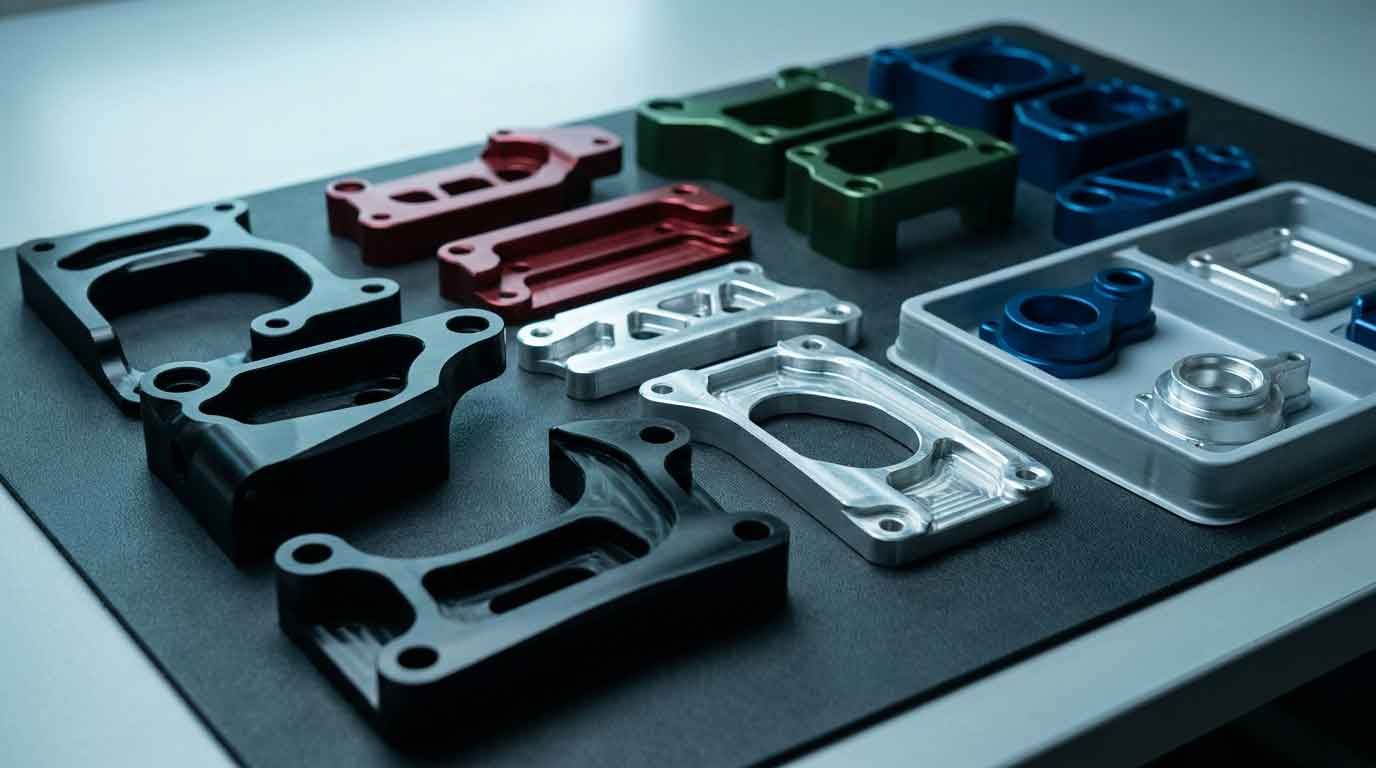
Black, red, green and blue are on the shelf. Clear is not a color: it is Class 1, undyed, and it is what a print calls out when the part needs protection rather than a look. Most drawings name the type and class along with a plain color, like Type II, Class 2, green, because the color is there to identify the part. If you need a color we do not stock, please tell us what you are matching and roughly how many parts are in the run, and we will tell you what it takes.
How the work runs
Five steps between the pallet and the box.
01
Parts in
Received and counted against your purchase order before anything moves.
02
Masked and racked
Anything that has to stay bare gets masked, and we agree on the rack contact points with you before the rack goes in.
03
Anodized
MIL‑PRF‑8625F, Type II or Type III, Class 1 or 2 to your specification.
04
Inspected
Inspected off the rack, for coverage and for finish, before anything is packed.
05
Marked and packed
Laser marking where the print calls for it. Then packed to arrive the way it left.
What it does
Quick facts about our finish.
Direct current in a sulfuric acid bath grows a porous oxide up out of the aluminum itself. The oxide coating is grown from the metal rather than added on top of it. The top of your part is converted into something harder than it was, and four things follow from that.
It cannot flake off
There is nothing separate to come away. The oxide is the top of the part rather than a layer resting on it, so the surface that takes handling and weather is the metal’s own. What corrodes, if anything does, is the oxide.
Hardcoat trades something for that hardness
Type III runs thicker and denser than standard anodize, which is why it goes on bearing faces, slides, and anything that gets worn on. That same thickness wants a larger edge radius than a print may call for, and a sharp corner is the first place a hardcoated part chips. Please bring us the print before the tolerance is set, and we will tell you what the coating does to it.
The part comes back bigger
About half the coating grows out of the surface and half grows into it, on every face. A bore closes. A shaft grows. A threaded hole moves more than either one. None of that is a defect. It only becomes a problem when nobody tells us the print has to survive a finish, and the tolerance math behind it is worked out on Standard Machine’s machining page.
Color holds, and shade has a range
Sealed color holds up well in service, and how well depends on the dye: one chosen for light fastness keeps its color far longer in sun and weather. Shade is a separate question. Dyed color lands in a range around the target, a little lighter or darker from batch to batch, and two parts from the same tank can differ slightly. Holding the chemistry in line keeps that range tight. If a part has to match an exact shade, please let us know before it runs.
Capacity
Our longest tank runs 120 inches.
That is the first thing people ask, so here it is up front, and it is the undyed line: Type II and Type III, Class 1. Dyed work runs in smaller tanks. Length is only one of three numbers either way, so please send all three with the color and we will tell you what fits.
Any part Standard Machine can cut, we can anodize.
120 in
Largest tank, length
Width and depth on request, and the dyed tanks are smaller. The alloy matters as much as the envelope, so send both.
Proof
More than half of this line’s work walks in from another shop’s floor.
We built a full‑scale anodizing shop, at first to anodize the parts manufactured by our parent company, Standard Machine & Manufacturing. It was not long before we decided to meet a recurring demand for anodizing from other machine shops. Today our shop stays busy meeting the demand of our own shop and of the other shops who have come to rely on our quality and reliability.
We take the part as it arrives. Some of those shops run their own aluminum and send out only the finish, and some of those parts need masking or laser marking as well as color. Before anything goes in the tank, we are glad to point out whatever on the print anodizing is going to change, because that conversation is an easier one to have before the part is coated.
A proven supplier of machined components, assemblies, and engineering services provider for the last 4 years... their anodizing line has proven to be cost effective and schedule compliant on 3 Day Quick Turns.
JR Automation
Before you ship
Questions we get before a part ships to us.
Will anodizing throw off a tight tolerance?
It does change the size, and it changes it in a way we can predict. Please tell us which features have to hold a number after anodize, and we will tell you what the finish will do to them before the part goes on a rack. That is a much easier conversation to have before the run than after it.
Will anodizing cover machining marks or scratches?
No. Anodizing converts the surface of the part rather than coating over it, so it will not fill or smooth anything. Machining marks, scratches, staining and porosity stay visible, and the finish can make them easier to see. Surface roughness also changes how the color and the gloss read. If the part has to look a certain way, please get the surface where you want it before the part ships to us, and tell us what you are after.
Can you mask a bore?
Yes, and masking is ordinary work here. Please tell us what has to stay bare, and we will agree on the rack contact points with you before anything goes in the tank. We offer flexibility on the point where your part hangs on the rack and appreciate your input.
Can you hardcoat 7075 or 2024?
Both alloys anodize and both take hardcoat. The spec does not bar 2024 from Type III. Please send the alloy and temper with the part, along with whatever thickness the print calls out, and we will tell you what we can hold.
Do you seal hardcoat, and does sealing make it softer?
Hardcoat goes out unsealed unless you ask for it sealed. Sealing closes the pores and helps corrosion resistance, and it costs some of the abrasion resistance that is the reason for Type III in the first place. Which way to run it is your call, and we are glad to talk it through before the order.
Why did my black parts come back with a purple tint?
Almost always the seal rather than the anodize, either the seal chemistry or the timing after dyeing. Please send us one that did it and we will be glad to tell you what we see.
The machine shop
Standard Machine, at this address.
CNC aluminum for aerospace and defense, ITAR registered, at 104 Industrial Drive in Greenville, Kentucky. The finished part comes straight into these tanks.
- One print, one purchase order, one lead time
- Fixturing and racking worked out together, before the program is written
- The part is machined and finished before it ships anywhere
- Your drawing stays at one address, and so does the part
- One number to call for an update, machining or finishing
CNC Aluminum Machining 104 Industrial Drive · Greenville, Kentucky
Request for quote
Send us the parts.
Please tell us the alloy, the finish, and how many. You will hear back from the people who will run the job.
Greenville, Kentucky · 104 Industrial Drive
What to send with the parts
- Alloy and temper
- Quantity, and whether this is a one‑off or repeats
- Finish: clear, hardcoat, or black, with the type and class off the print
- Color, if it is not staying clear
- Coating thickness, if the drawing calls one out
- Anything that has to stay bare, and where the racks may touch
- Masking or laser marking requirements
- Surface condition, and anything cosmetic the part has to meet